Showing posts sorted by relevance for query watch. Sort by date Show all posts

Wednesday, October 1, 2014

Metametacognition - a new art

I came in second in a disco contest hosted by the young adult librarians of the PA Library System in 1979.   First prize was a gift certificate.  Second prize was a candle that had been poured into a dug out mold in the sand at the shore.  

 Yup, I was big into disco.  I still own the soundtrack (on vinyl) to Saturday Night Fever, along with a host of other albums featuring the Bee Gees and Donna Summer.  And while I never figured out who left the cake out in the rain, or why someone would lose the recipe to such a valuable delicacy, disco continues to be part of my life.

No, not because I'm twirling around my kitchen, or randomly pointing to the ceiling and the floor.   It's more the metaphorical disco that haunts me today.  That, and an occasional spin of those songs on my ipod.


Today is my first day as a solo blogger.  Te@chthought gave me no prompt, and I'm dancing alone.  Guess what?  I'm still reflecting -- as much as that mirrored ball on the ceiling at the disco.

Here's what I thought about as I went to sleep last night:  The last thirty days have been an intense period of metacognitive study.  Seriously -- metacognition  by definition -- is thinking about thinking, right?  So the last thirty days have been metametacognitive for me.  I've spent thirty days reflecting on thinking about thinking.  Perhaps I should shorten this and go with M2cognitive as my new acronym.  It will be famous.  (But only if you start to use it for me!)

On Monday, I was once again reminded that teachers should never dismiss opportunities for their students.  Each semester, I advertise six Secondary Enrichment Experience seminars that are offered through our local Intermediate Unit.  Janice, the coordinator, works diligently to find a variety of hands on experiences for the senior high gifted kids in the county to explore.  They range from lectures and art opportunities, to watching and interacting with engineers and surgeons.  I think you get the idea.  Monday's topic was "Explore the Art of Swiss Watchmaking."

Seriously?  When was the last time you wore a watch?  I have a clock on my wall, a clock in my classroom, a clock on my phone, and the new high school even has clocks in the hallways.  Watches are SOOO 20th century.  I couldn't imagine that there would be much interest in this, but I put the description in my googledocs survey, and almost 15 kids were interested.  One was so passionate, that he appeared in my doorway, BEGGING to be able to attend.  We were offered three spots in the seminar, two kids returned permission slips, and one backed out at the last minute because of an obligation to a group presentation.  So Alex went alone.

I had the joy of picking Alex up after the seminar at the site.  I sat in the van and watched as the busload of students from around the county exited the building.  I scanned the group, and noticed that there were quite a few were leaving after first stopping to say goodbye, or interact with Alex.  This didn't surprise me, as Alex is quite a nice guy, who everybody loves pretty quickly.  Alex stopped -- to take pictures of the OUTSIDE of the building.  Hmmm. Curious.  Then he got in the van, and went insane.

Yes, insane is the only word to describe the excitement this kid had for the last five hours he had spent learning about the fine art of watchmaking.  I have never seen anyone so passionate.  He talked about the interconnectedness of engineering and art, both passions of his, and how watchmaking touched his very heart and soul.  Oh, and wait.  

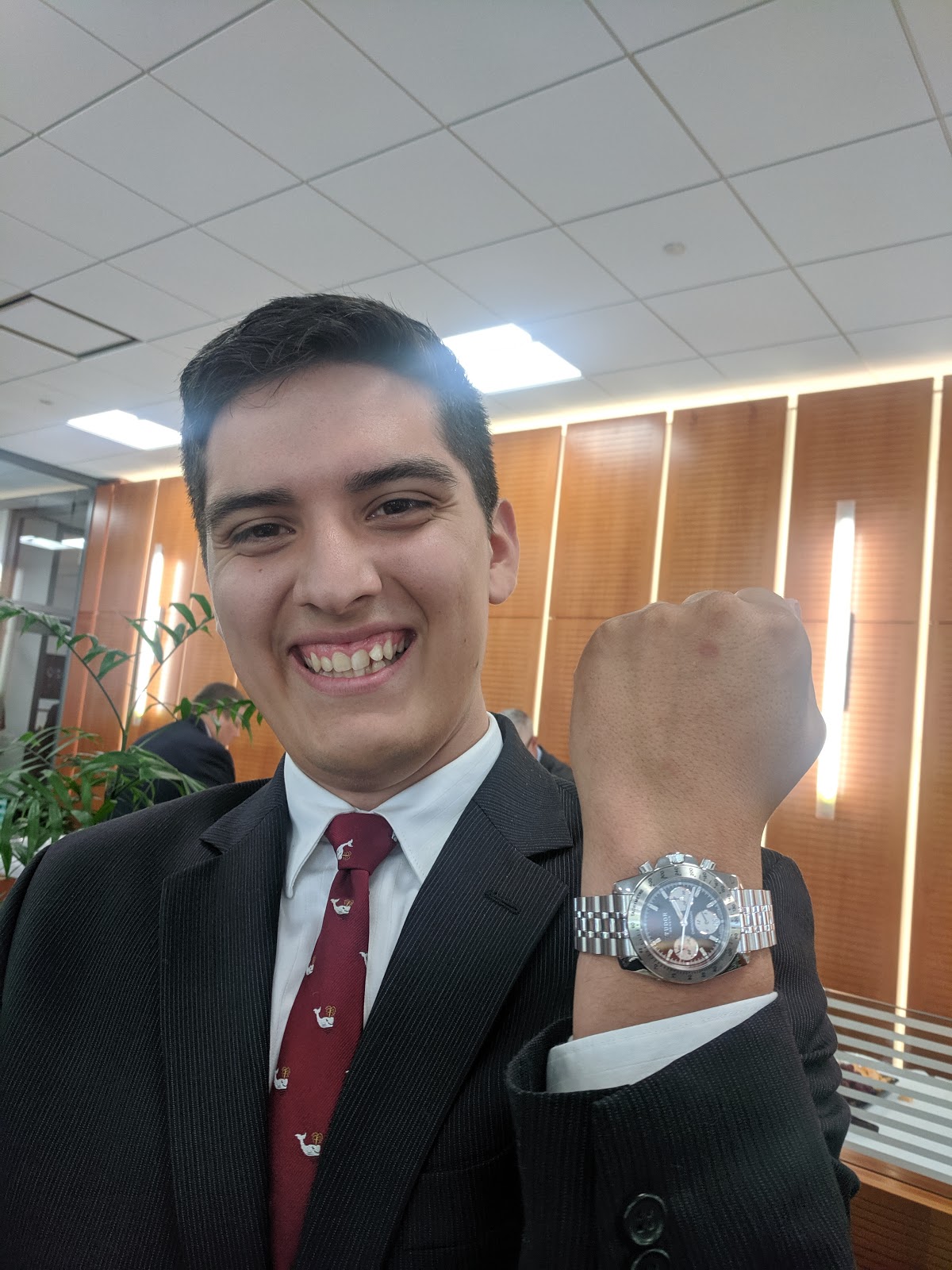
HE MADE THIS WATCH.  

Seriously.  He made a watch.  

Alex is a senior.  It is entirely possible that he is on his way to a six figure job with Rolex. 
And I almost decided for him that a day watching watchmakers wasn't relevant.

Should I keep reflecting?  You bet.  Because the next time the SEE Seminar list comes out, I will remember that day in September when I fought back the tears as a high school senior discovered his passion.  

Thirty days may be over.  The disco ball mirrors are still reflecting and shining in all corners of my mind.


Saturday, May 23, 2015

A Giant Jar of Glitter.

Shortly after my grandson, Carter, turned two, I was visiting his house with a new toy -- a new watertable -- a gift from his great grandmother.  Jennie, his mother, and I assembled it in short fashion, and filled it with water.  It came with two small plastic sailboats, among other things.

Carter played, standing next to the table, trying to sail the top-heavy sailboats, which kept sinking.  It was frustrating, as an adult, to watch as he repeatedly tried to right the boats.  Soon his body was tensing, he was gritting his teeth, his face was getting more and more red.  

I braced for an explosion.

Instead, he pulled his hands out of the water, shaking them in front of him, and walked to the corner of the yard, saying "walk away, WALK AWAY," as I watched in disbelief.

His very wise mother had, somehow, instilled this sense of reflection, and ability to remove himself from difficult situations, without outburst.  And he was only TWO at the time.

Carter is now four.  There are fewer instances of "walk away", and more red-faced meltdowns, which I attribute to his observation of others at school and in society.  (Because, after all, he is my grandson, and I think he's wonderful!)  Jennie still reminds him, as the meltdowns bubble up, and often diffuses whatever drama is currently facing his brain.  

Walk Away, Walk Away.


A Giant Jar of Glitter.

I instantly flashed on Carter's diffusing strategy this morning when I came across an article about a school in Mar Vista, California, that is teaching mindfulness as it relates to anger.  The related video is astonishing, considering the age of these kids.  

I'm shopping this weekend for a giant jar, and glitter.  Why wouldn't this same analogy work for academically overwhelmed students with fixed mindsets?  It was a lightbulb moment for me when I realized that Carter's walk away strategy is a tool that would benefit everyone in my classroom -- okay, in society -- not only for anger management issues, but for dealing with anything overwhelming.  Especially difficult content, multiple tests, and high-stakes evaluations.  The impossible challenge of final exams in two weeks or the pile of final projects and papers that have deadlines that can't be extended.  

What our classrooms need are giant jars of glitter, lava lamps, and anything mesmerizing enough to get kids to pause and reflect, to open their minds and accept their potential success.

Sparkly things are widely celebrated.  If my brain is a giant jar of glitter, at least give me the chance to breathe and watch it settle.

Saturday, April 11, 2015

The man behind the curtain.

I hated the Wizard of Oz from the age of 6 until well into my forties.  Yes, I know it is a beloved tale of the importance of family and home, but when you're sent to bed by a rule-following babysitter in the middle of the flying monkeys scene, well, you're scared witless.  (Or something that rhymes with that.)  

Every year, during the annual showing on network television, my sister and I would be offered special dispensation to stay up past the usually appointed bedtime to watch the movie.

And I would flatly decline.  

All these years later, I remember curling up on the hardwood floor in the doorway to my room, sobbing in protest of the "stay up and watch the movie, or go to bed" option, flatly refusing the comforts provided by my parents -- apparently only identified as my bed and the area rug underneath it -- choosing the hardwood floor and a quilt made by my grandmother.  (NOT MY PARENTS!)

Suffice it to say, I was not in a Growth Mindset.

 Pay no attention to the man behind the curtain.

 While we're on the topic of classic childhood movies, sing along for a minute with this classic from Mary Poppins:

"If you want this choice position.... 
Have a cheery disposition..."
 
Jane and Michael Banks new what they wanted in a nanny.  Disposition is number one, in their book.  To be honest, it's number one in all of our books -- why would you want to interact with anyone with a less than positive disposition, after all?  

Yet it's the number one struggle of teachers, fighting desperately for the academic (and personal) success of their students.  

Certainly Carol Dweck's mindset research is valuable -- if the kids in the class are willing to face the flying monkeys that are keeping them from embracing the concept.  Katrina Schwartz, at Mind/Shift, offers some alternatives to fostering the embracing of growth mindset in her article, What’s Your Learning Disposition? How to Foster Students’ Mindsets.

Take a read, and see how a simple shift in the way teachers approach student learning, including a raw and honest transparency of their own failures and how they rose to overcome them, is critical.

Especially in this week when we've deemed our elementary students "Ready for the Test," as they face the almighty PSSAs.  (Certainly my co-workers are willing to show no shame in their video encouragement!)

We need to find a way to bridge the gaps between outside of school where kids feel successful about something, and in the academic world.  Partnering with our students to understand a bit about the obstacles in their lives, no matter how silly they seem to us, may offer a key to unlocking that growth mindset that they've had all along, but never looked for.

So what finally happened to allay my fears of the folks in Oz?  Our faculty and staff performed Wizard of Oz as a fundraiser for the scholarship fund.  I was one of the talking trees who tossed apples at the scarecrow, wearing a brown velour tree costume that still causes new nightmares, when I think about the fact that I was on stage in something that unflattering.  Oh, and my fear of flying primates?

My daughter, along with a dozen or so of my colleagues' kids, became flying monkeys. 

It's difficult to hold a grudge against your own eight year old daughter on rollerblades, sporting a tail.


Tuesday, July 21, 2015

"Elementary, dear Watson!"


I was reminded of the power of deductive reasoning yesterday when I was shopping with my daughter.  We both have a fascination with tiny things that others would consider to be entirely impractical, yet we tend to hold up the "cute little whisk" or the "tiny little spatula" and talk in a tiny voice to each other, filled with baby-talk excitement.  Yesterday, in addition to the miniature spatulas and whisks, we discovered the most adorable funnel.  Although I didn't buy it, it will be with me all year this year, in the form of some classroom art explaining the importance and process of deductive reasoning.

We've all heard of the power of deductive reasoning; especially when contemplating the mystery-solving brilliance of Sherlock Holmes.  Tons of facts, tons of false leads, and evidence and non-evidence to be sorted through, slowly accepting and rejecting the tiniest lead, until the ultimate answer is discovered.  It's a systematic process used in many careers -- and a skill that we don't spend enough time teaching students.  (Yet many professions use funnels as a metaphor or illustration for success!)

Consider the almighty funnel.  Entering the wide opining at the top, all sorts of information.  Consider the facts, let the kids decide what the causes and effects were to a given situation.  Watch the inquiry and discussion.  Watch the debate.  Guide them, a bit, but not too much!

Joshua Block, a teacher at the Science Leadership Academy in Philadelphia, uses this inquiry strategy frequently with his students.  (Read more about his class and work here.)  It's brain work.  It's collaboration and communication.  And it's engaging.  Oh, and the best part about funnel teaching?

It works both ways.

WHAT?  Yes.  Turn that funnel upside down, and introduce the concept of brainstorming.  Into the point of the funnel goes a single topic, and then the mind-whirling begins.  Idea after idea is generated.  Excitement ensues, and ownership follows excitement.    Once the pool is full of ideas, the funnel can be flipped again, with those involved working to solidify the best possible option.

Yes, simple funnels can serve as metaphors for both generating big ideas and whittling down to small solutions.

And they can also elicit baby-talking high voices in the housewares section of at least a few people I know -- including me.


Tuesday, June 2, 2015

Kids Say the Darndest Things...

My classroom has two large whiteboards -- the one in the front of the room is flanked on either side by bulletin boards, and the large expansive one in the back is nearly the width of the room.  Given that most of the attention in classrooms these days is directed toward wherever the projector is focused, the back board gets little attention.

Oh, sure, the list of kids with outstanding assignments, or a list of borrowed books or Nooks might be posted back there, but basically my back board has become its own brand of urban graffiti. 

As I'm sure you're aware by now, there are many creative and/or artistic kids that wander through my room.  There is also a lot of time that allows for quiet, or not so quiet, conversation while brainstorming.  Several weeks ago, I wrote an entire blog about the calming influence of avocados, which certainly  was a comment that was rooted in such a classroom experience.   Somebody said it, somebody else thought it was unusual, and added the quote to the back board.  Recently, one of the quietest kids informed me that he was probably going to major in "marketing, probably.  I like to manipulate people."  Certainly surprising news, although upon further consideration, I voted him "most likely to become a trained assassin" given that no one would ever suspect him of anything surreptitious. 

So yes, Rheeana is a Welsh Goddess, and Alex is poor, handsome and smart.  Avocados and carrots are admired, and well, Tom continues to offer lessons on reading the body language of people.  (Watch their eyes, people, watch their eyes.)

At some point, a well-drawn octopus appeared.  Through the collaborative efforts of many classes, that octopus has evolved into Stalipus, sporting a rather bourgeois-looking hat along with his hammer and sickle.  Sometimes the content of the back board raises some eyebrows, sometimes it sparks discussion.

But mostly, it's a collaborative space that fosters a sense of community, security, and trust.

Even if it does sometimes feature bourgeois dictators with eight legs.


Friday, June 5, 2015

Why can't I sleep?

I've been awake since 3:30 am, answering emails, and just generally processing a giant list of TO DOs that need to be done before the end of the year.  I was at school shortly after 6:30, and finalized all the grades that I could by 8, just in time for the June fire drill.

Which conveniently got the entire student body out on the lawn to watch the parade mentioned yesterday.  With the help of some dedicated student volunteers, I was able to rescue about 2 pounds of UHU putty from various posters on my walls, and strip my room down to its naked summer state, all before lunch.
 
The hallways emptied shortly before noon, with nary a lock left on a locker.  And the afternoon grading and report card duties flew by.  I forced myself home by 3:45, hoping to grab an hour-long nap before commencement this evening.

But I am too excited.

Seriously.  My own kids have all graduated.  This should be just another duty on my list of end of the year duties, but I'm eagerly anticipating commencement this evening, even if they've moved it inside due to the threat of thunderstorms.  Two of the student speeches will be given by students of mine, and I am anxious to watch and listen to them as they charge their classmates to move forward.

By the time I got home, there were many posts on Facebook from current juniors proclaiming the beginning of their Senior Year.  To them I say, SLOW DOWN!  

I can only mourn the loss of one group of great kids at a time.


Wednesday, October 8, 2014

Engaged!


After teaching for more than fifteen years, and becoming facebook friends with a number of present and former students, my feed is starting to fill with a lot of diamond ring pictures.  The excitement of a new phase in a relationship,the planning of the event to end all events, and a happily ever after sets the most romantic of us abuzz as we watch these young people find their place in the world.


Add to that the number of friends I have who are professional or amateur photographers capturing gorgeous pictures of spectacular days, and it's easy to become a creepy stalker as I watch the stories unfold.  I try to limit the number of pictures I "LIKE" on facebook, fearing that my former students will wonder what I do with my spare time, and why I seemingly care so much about them and their successes.


Why do I care?  or, more importantly, Why don't THEY care?


Of course I'm speaking metaphorically here -- especially on the heels of yesterday's post about the motivational properties of chicken bowl.  But the situation is similar; students today are more excited to tweet, instagram, or facebook accomplishments as mundane as they lunch they are eating or the shoes they are wearing than they are about what they are actually doing to better themselves.  And while social media has made this so much more prevalent in the twenty-first century, the actual history of this sort of lack of enthusiasm predates even the internet.  (GASP!)

"What happened in school today?" was often the question asked at the dinner table when I was a child.  I know that I am not alone in this ritual, as similar scenarios are played out in sitcoms from the 60s and 70s, and I've even seen a rerun on MeTV of The Beaver skirting the question from his father and mother.

Perhaps the problem is the way we are planning and instructing our students.  AJ Juliani posted a very thought-provoking blog entry yesterday entitled This is not a Lesson Plan.  I've spent some time reflecting on this, and find a distinct connection between student engagement/excitement levels and  what they are willing to talk about, or tweet about, etc. with others.  Often, as AJ suggests, they are excited about the technology or the activity, but are they really learning and retaining the information? I am now asking myself whether my lesson plans are truly Learning Plans, and if they aren't why aren't they?

Reflection on learning and lessons and student engagement is now my new obsession.  I'm standing on the tip of an iceberg, trying to examine what stands beneath my feet, without cracking my head as I slide off into the great abyss that is the psychology of education and engagement, before the ceremony called graduation becomes the next tweet.


Friday, August 28, 2015

Friday!

It's official!  We have the first week of school under our belts, and will have two weeks completed prior to Labor Day.  Granted, students were only with us for three of the five days, but the names are starting to match up with the faces, and the personalities are beginning to shine.

Given that I teach half-credit courses, I only see each class every OTHER day, so three classes have seen me twice, and two have seen me once.  We've had a day of learning to relax, focus, breathe, and focus a bit on thinking, and most of the classes have already worked as individuals or in small groups to practice their Analyzing Relationships skills, while creating something for me woefully bare walls.

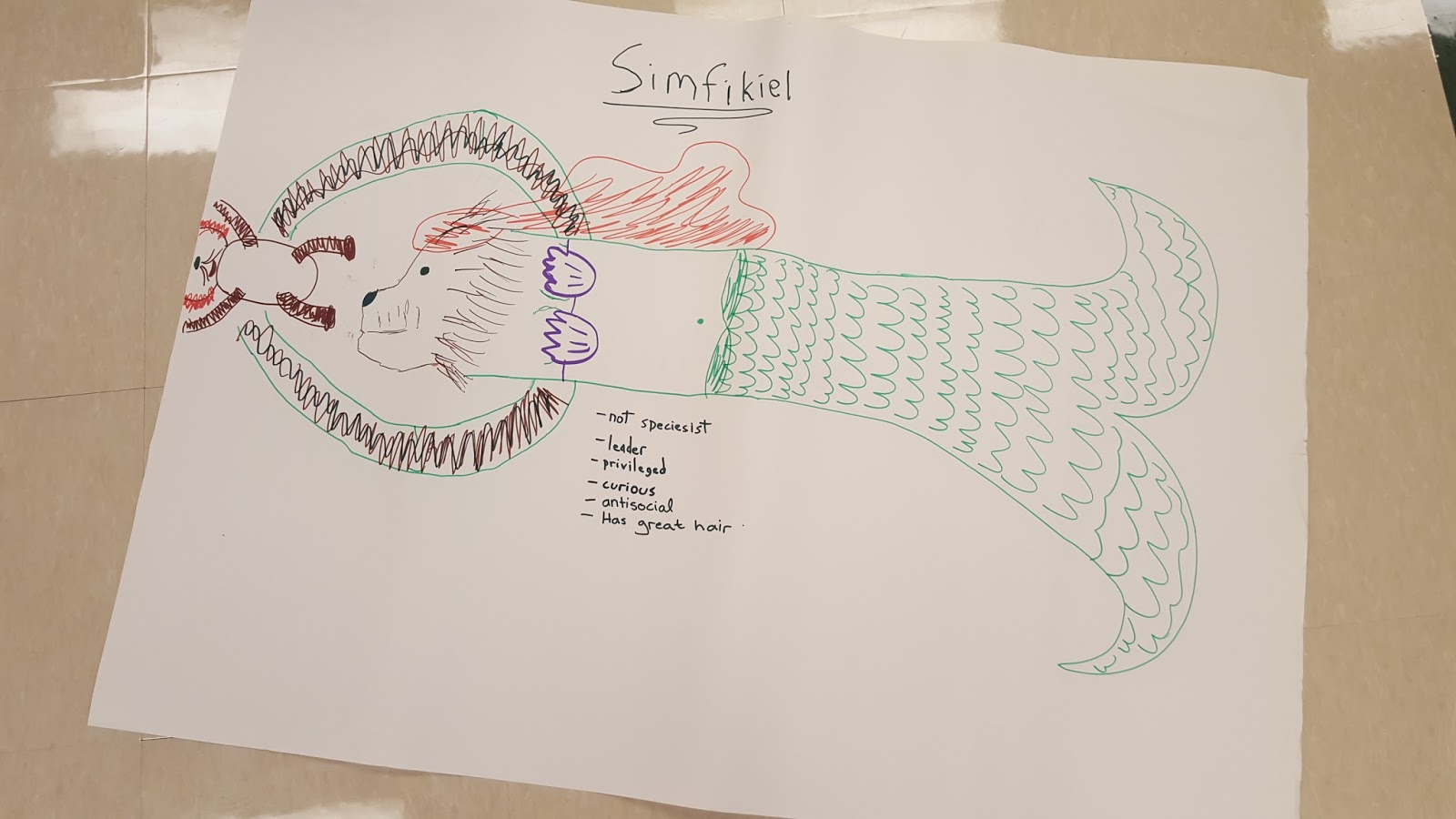
For the Themes in Lit. folks, the first round of shared SCAMPER characters were presented.  A simple assignment -- identify a character owned by Disney, and work with two other people, and their characters to:

Substitute
Combine
Adapt
Modify
Put to other uses
Eliminate
Refine

and create a new character.  This assignment gives me a chance to watch kids get to know each other, readily identify the leaders, perfectionists, "I don't think I'm creative"s , and other personality traits and styles.  It's a BREATHE lesson, with a lot of thinking, laughter, and a first attempt to get back into the groove of creative thought and exploration.

So here are the candidates:


It was awesome to watch the process, and even more amazing to see high school students discover that they felt confident drawing -- especially since the assignment was about the PROCESS, not the perfection of the product. 

Next week, I get to do it two more times with the two other classes.

Meanwhile, the White Books already have entries in them, and the metacognition journey has begun.  Welcome to the 2015-16 school year.

(Oh, by the way, did you know that most of the kids in my freshman class were born BEFORE 9/11?  Talk about time-flying reality checks...)

Friday, July 26, 2019

It's About Time!


Almost five years ago, I told the tale of Alex, who had attended a SEE (Secondary Enrichment Experience) Seminar entitled "The Art of Swiss Watchmaking."  At the time, the idea that high school students would be interested in an entire day watching people make watches seemed pretty unlikely to me, yet Alex, being Alex, jumped at the chance.  He went on to receive a full ride to Franklin and Marshall College, yet the gnawing memory of that day at the Lititz Watch Technicum continued to haunt him.     

Alex walked away from Franklin and Marshall, and into the very selective and rigorous program at the Lititz Technicum, learning the secrets of  fine watchmaking, taught by the experts at Rolex.  Two weeks ago, he sat for what I can only assume was the most rigorous test of perfectionism, proving his steady hand and keen eye, and whatever other skills are key to the success of a watchmaker.  That afternoon, he sent me a message, inviting me to his graduation ceremony.  My response, "I WOULDN'T MISS IT FOR THE WORLD!"

So today, I had the privilege and honor of watching this very wonderful young man start the next phase of his life -- as a Rolex Watchmaker.  In his speech at the graduation ceremony today, Eric Grippo, the Manager of Rolex World Service, GENEVA, spoke about the passion of the seven graduates of the program.  I've known Alex since third grade, and he's been passionate about many things.  Mr. Grippo suggested that his father's goal for him had been that he find a career where he was so passionate about what he did that he would never feel like he was working a day in his life.  He enthusiastically welcomed Alex, and his classmates by saying "Welcome, to the first day of not working, beginning tomorrow!" 
Alex, and his gorgeous Betsy.


The best part about this day was seeing the genuine love of life this young man has.  His family travelled from far and wide to be in attendance, and every single one of us was hugged, and kissed, and appreciated by the reason we were all there.

So yes, there's never enough time in teaching -- or many careers for that matter.  For Alex, the rest of his career is all about time.  

And it is days like today that make me so very grateful that I have a career that, despite a 20 year pin on my lapel, is actually one that has me feeling like I haven't worked a single day.  Mr. Grippo's speech solidified the very thought in my heart that I feel every time someone stops me and asks me "How many more years do YOU have?", implying retirement is overdue for me.  Somehow I've blinked, and five years have passed.


Oh, and reminiscent of Alex's first day at the Technicum five years ago, he's sporting a new watch on his wrist.  (No word on whether it glows in the dark, although I suspect it does!)  

Clearly, those dimples are evidence of his passion, pride, and complete joy that comes with this achievement.

My prayer is that all of my students can find their dimples -- whether or not a Rolex is part of the package.  Because the joy of watching this kind of happily ever after is reinforcing the heart of this not-ready-to-retire teacher.

Thanks, Alex, for the invitation, and for reminding me what I've known all along.  Magical things happen when gifted kids discover their passions.


Sunday, October 30, 2016

Doodle Do!


I've been practicing the fine art of sketching the perfect cube for more than forty years.   Granted, I don't spend a lot of focused time on this task - usually it is practiced in the margins of notebook paper, or something else laying on my counter or desk - but cubes have been a part of who I am, whenever I have a pen or pencil and paper at hand.  I really don't know why I doodle, and I don't feel very creative when I do, yet it is an automated action that just seems to happen.

Turns out its Okay!

When I was student teaching during the last century - yes, sometimes I feel THAT old -- we were actually warned to watch out for doodlers, and find a way to get them engaged in the lesson.  The assumption was that anyone doodling semi-perfect cubes couldn't possibly be listening and comprehending the lesson.  Yet the research that has been put forth in this century suggests that doodling is no longer on the no-no list for students.   Mind/Shift outlined much of the research that exists, supporting doodling or sketchnoting.  Sunni Brown has a fabulous TED Talk on the topic as well.  So why isn't everyone doodling in every classroom?

Fear.

Face it.  If it has never done it that way before, and you're a student who views every class as something that you aren't interested in OR too valuable to toss away traditional note-taking, chances are fairly good that the idea of drawing pictures isn't high on the list of skills one might attempt.  Yet there are some excellent RSAnimate lectures that have been sketchnoted, which recognizes all the value of multiple intelligences learning.  (Go ahead, watch the Ken Robinson talk on Changing Educational Paradigms -- even if you've watched it before -- simply to consider the power of the sketchnoting!)

Try it on something that might not matter.  Maybe you'll discover that doodling your way through a lecture with intention is exactly what you need for meaningful understanding.  Or perhaps you'll be able to refine your cube-sketching skills to something worthy of fine CADD sketches, or be able to draw Skippy on the back of the matchbook.  (Which really, is soooo last century!)


Sunday, June 4, 2017

The Essential Question.

I watch television.  A lot.  The reality is, if I'm at home, chances are pretty good that something - usually CNN these days -- is on in the background.  But, aside from The Big Bang Theory and Antiques Roadshow, there are very few shows that I actually sit DOWN to watch.  So when the opportunity to actually take my stuff and have it appraised on the Roadshow, I eagerly submitted my email address, hoping to "win" two free tickets, knowing that luck is not usually on my side when it comes to random drawings.

This time, I actually won.

Mr. Peanut was actually a woman!

Each attendee was invited to bring two precious items for appraisal.  Bruce and I spent many days mulling over what we would choose to take.  As those who know us well know, we do a lot of antiquing, and sometimes we even buy something.  Bruce focuses on militaria, and I, well, am inspired by whatever amuses me or makes me wonder.  In my defense, it's also how I teach my students -- amusing them first, and then making them think about the bigger picture.  

In education, teachers today are encouraged to teach, by first asking an "essential question."  For everyone in line yesterday, at least one of their essential questions was "What is this _________ worth?" , as each of us hoped to discover that we possessed the holy grail of  antiques.  Bruce chose to take a Revolutionary War sword and an inscribed powder horn.  I chose a textile - a sort of banner, designed to celebrate the centennial of George Washington's inauguration that I had purchased several months ago at The Mad Hatter in Adamstown for less than $20 -- and a pen and ink/watercolor whimsical piece I had purchased in Connecticut about five years ago.

As we headed off to this adventure, I knew virtually nothing about either piece, despite many hours of research and googling.  My family has never batted an eye at the textile, choosing to spend most of their time humiliated by my ownership of, as we call it at home, "The Wang."


The Wang

Have you ever seen something that you were attracted to, and overlooked something else that, later, became painfully evident?  In my world, The Wang is the epitome of the overlooked, yet hyper-obvious.  I discovered it in the 50% off section of the Mansfield General Store and Antiques, in Mansfield, CT, while at UCONN.  I like watercolors, and I love whimsy.  I was amused by the piece, I was homesick, so I bought it -- for $37.50.    I am sure that my family considers this to be a truly ridiculous investment, yet it has brought me considerable joy and entertainment in the few short years that I have owned it.  Fortunately for me, when I returned home with it, they were too happy to see me to criticize my newly-acquired original Wang to my face, assuming I new the entire content of the painting.  I didn't discover the obvious until more than a year later.

The Roadshow experience was fantastically exhausting. My Fitbit clearly lies about my physical activity yesterday, because I know I walked - and stood on the cement floor of the Farm Show Arena - more than 4534 steps.    We arrived shortly before 2:30 pm, and left almost five hours later.  


The Washington textile, roughly an $18 investment, is worth between six and eight HUNDRED dollars.  Bruce discovered the sword, which he had thought might be fake is actually authentic, and was surprised to learn that the powderhorn was not what it seemed.  The last appraisal of the day was The Wang.

Kathleen Haywood, a prim and proper woman from Massachusetts, was the appraiser to whom I was directed.  If you examine the close up of Wang's signature on my piece, directly above the signature is what can only be described as a pileup of whimsical animals.  (And if you think differently, get your mind out of the gutter.   They're fun, and they make me smile.) Prior to unveiling my item, when prompted by Kathleen with her inquiry "What did you bring me today?", I stammered through my rehearsed answer:  

"I've always loved watercolors, and whimsical drawings.  I found this in Connecticut.  It wasn't until a year later that I discovered the pornographic detail on the man."

Okay, so maybe that wasn't my best activating strategy, when introducing this new topic to this Puritan woman from New England.  Her immediate response:

"Did you NOT NOTICE the animals copulating on the side?"  

Why yes, yes, I had.  In fact, I hold them personally responsible for my inability to notice the aforementioned genitalia on the character at the bottom of the pile of humans for almost a year.

Fortunately for me, Kathleen had a bit of a whimsy attitude herself, which was evident when she put on her hot pink round spectacles, and scanned The Wang under her Ott Light, shared it with the appraiser next to her with a bit of a giggle, and began actively searching her databases.  

After all of her searching and evaluation, she came to the same conclusion that I had -- The Wang is priceless.

Okay, so maybe not priceless, but was not something she could identify.  She referred me to the Illustration House in NYC, suggesting that they might know more about Wang than she.

I'm confident that this most-recent obsession of mine will become a topic of witty comments and sarcastic criticism from many of my friends.  In fact, I'll be a bit disappointed if it isn't.  It should be known that I was able to actually activate my filter, and chose not to enter the Feedback Booth at the end of the day.  We met a lot of fun folks in line, including my line-mate, Bob, from Berks County, who suggested that I  enter the Feedback Booth and say, 

"I came to the Antiques Roadshow today to find an expert on mid-century pornographic whimsical watercolors, and am severely disappointed!"

After all, doing so might embarrass my family, and they have so few coping skills in dealing with my eclectic collecting habits.


Tuesday, May 5, 2015

Roadshow and the Feedback Booth.

My husband, Bruce, and I are avid fans of PBS' Antiques Roadshow.  We play a bizarre game of "Keep It,"  "Sell It," and "Do the World a Favor and Break It", when we watch, evaluating each item up for appraisal through a personal lenses of value.  We're getting pretty predictable in our responses, now that we've spent more than a few hundred hours watching the show and wandering through various antique stores and malls in the area.

Bruce is as overwhelmed at the prevalence and ridiculous values of Fender guitars, as I am at Asian and Native American art.  Suffice it to say that if we were to suddenly be presented with any of these artifacts, we now know enough to have the stuff appraised before hauling it off to Goodwill with a hearty "good riddance."

   Roadshow and the Feedback Booth.

Oh, sure, Susan, you're saying.  Obviously you're going out on your "National History Day is coming next week and we should all pay attention to the past to celebrate the present" limb.  Well, yes -- and no.  Of course I'm excited about NHD, and I do love a good connection to the past while living in the comfort of the 21st century.  I also have spent a fair amount of time, recently, considering how much the people on the roadshow (contestants?  partakers?  antique owners?) remind me of my classroom.

Consider the parallels:

The Guy with the Fender guitar, case, and amplifier left to him by his grandmother.  (Yes, that was the sound of Bruce sighing in the background as yet another guitar was appraised by the smooth-talking southerner acting as if he'd never seen a guitar this good in his life when we all know better...)  The set was worth $30,000.  Yup.   The poor dude was speechless. 

And then he uttered the words:  "Well, I guess I shouldn't keep it in the closet."

Seriously?  You didn't like it enough to keep it out and look at it, and now that it's worth thirty grand, you're going to put spotlights on it and decorate a whole room in your house with the guitar as the focal point?  

Similar comments are made of strange, weird, ugly artwork that nobody in the family likes, and you know the darned painting or sculpture was dragged to the Roadshow more to prove it's worth nothing, only to have owners tearing up and celebrating something suddenly deemed worthy by an antiques appraiser.

You'd better believe I'm sitting on my sofa chanting "Sell it, Sell it!"

Other items brought to the show are family treasures.  The baseball caught during the World Series signed by the entire Yankees team, with all sorts of provenance to the grandfather of the now-owner.  Or the military diary, sword, or drum from the Civil War that has been passed down through the family.  It's clear that a big dollar appraisal on these items might actually stress out the owners, who vow, before the appraisal, that the item isn't for sale.

I have to admit, sentimental ancestral connections always elicit the "Keep it!" chant, even if it's just in my head, as my heart is smiling as I watch someone who truly gets it.

So what makes people value antiques?  Is it because someone tells them to value them, with a monetary appraisal that suddenly makes them care?  Is it emotion that connects them to their ancestry?

And what makes students value learning?  It certainly doesn't seem to be because someone tells them to value the information.  Are students emotional about what they are learning?  Hmmm.  Maybe if they can connect, on a personal level, with a teacher that they trust and respect.

This week is Teacher Appreciation Week.  Our Student Council at the high school has encouraged learners to consider the value of their teachers and nominate those who have had a profound impact on them.  This evening, the Lancaster Newspapers is encouraging its readers to thank a teacher, (while featuring a 16 year old picture of my good friend, and Roadshow fan, Liz).   All of this retrospective thinking has reminded me, once again, of the shoulders of giants on whom I've been able to stand -- even if only for a year.  

So who are the teachers who taught you to value learning?  Who kept you from selling your textbooks at the end of the term in college, because you loved how much they loved sharing their subject?

Mrs. Brumbaugh, Mrs. Finegan, Miss Jungles, Mrs. Mahoney, Mr. Dresher, Mrs. Bovenkirk, Mrs. Johnson, Mr. Check, Mr. Rahnzahn, Mr. LaVelle, Mr. Dodds, Mr. Stewart, Miss Ambler, Mr. Gribosh, Mr. Erwine, and so many others, at Glenside Weldon and Abington who taught me to love learning.  And folks from college and graduate school -    Dr. Heston, Mr. Dunlap, Mrs. Best, and Mrs. White.  Sally Reis, Joe Renzulli, Sally Dobyns (who dragged me, on a sweltering 103 degree day into a cemetery in Connecticut -- all for the love of history), Jan Lapien, Del Siegle at UCONN.  I'm sure I'm leaving as many teachers out as I've mentioned, yet the love of learning shared by these teachers is still in my heart  -- some of them more than 4 decades later.

So much so, that if I had a letter from one of them appraised for big bucks on the Roadshow, I'd be hard-pressed to sell it.    Honest.  I'd even say that in the Feedback booth at the end of the show.


Sunday, January 18, 2015

"Every New Beginning is Another New Beginning's End."

'twas the night before band camp... —photo courtesy Leann 


I am fortunate (or maybe not, if you consider the potential ramifications for tears, gnashing of teeth, etc.) that my district has no policy in effect prohibiting teachers from being "friends" with students on social media. The community in which I teach is small.  So small, that when I went to a New Year's Eve party this year, I knew everyone there, and most of them were parents of students who are, or were, on my caseload.  There's a pretty fine line between my social life and my work life.  In fact, it probably barely exists, given how many of my friends are also parents or former students.

Every summer, usually beginning the first week of August, a picture and post (see above) appears on Facebook, posted by a parent of a senior:

  "This is the last time that (insert senior name here) will (insert event here)."

After serving as the biological parent for the high school graduation of my youngest child in 2012,  I thought I was home-free.  I could go to graduation, hand out scholarships, often listen to one of my gifted kids give the valedictorian speech, attempt to sing the Alma Mater without embarrassing myself too badly, and head off to some graduation parties, all while wearing non-waterproof mascara.  That has not proven to be the case.

Given that I have known some of these kids for more than a decade, suffice it to say that they may not be biologically mine, but I share many of the emotional ties that parents do.  I've seen sparks of excitement, anger, tears, and frustration.  And every graduation becomes more emotional for me as I have to say goodbye to another group of "my kids."


The Te@chthought Blog Challenge for today:
What do you intentionally do to make sure you don't let too much time pass without having a caring conversation with all your students?

Common Core, Essential Questions, Activating Strategies, Summarizing Strategies.  None of these address the need for a caring conversation with my students.  My connection with my students and their families on social media allows for the best place for a non-threatening, caring conversation.  For example, my response to the "Last First Day of Band Camp" post, captioned above:

Susan Heydt I swear, if these seniors start playing violins about the "last time" they do everything this year, I'm gonna wamp them upside their heads. I can't handle another emotional year of goodbyes!
August 4, 2013 at 9:35pm · Like 


 In my best Chandler Bing voice, "Could I BE any more caring?"

The moms in this conversation are parents of my seniors who graduated last spring.  It was also the first graduation of my students that I was unable to attend, as I was recovering from knee surgery.  Please indulge a bit of the rest of the Facebook "conversation" regarding this topic:

Parent #1 My daughter already started the "this is the last time" statements. She is excited to finally be a senior, but is a little sad too! And dinner did not involve pancakes. It's way to early in the season for that!
August 4, 2013 at 10:17pm · Like


Susan Heydt Like waiting for January snowflakes. Please extend my threatened wamping to her as well. She has already been happiness kidnapped once, and you live too close to Parent #1 to make it impossible for me not to visit TWO of them in one trip.
August 4, 2013 at 10:19pm · Like

 
Parent #1 You should stop by my house Friday night for induction so you can see them all at once!
August 4, 2013 at 10:21pm · Like

Parent #2 Michele...she will show up in her pajamas...I have a first hand primary resource
August 4, 2013 at 10:26pm · Like


I can assure you, dear reader, that there are at least two people reading the above, and are crossing their legs to keep from peeing.  Yes, to us, it was that funny, even if you fail to understand why.

How do I intentionally make sure that my students know I care?  I stalk them on Facebook (if they let me -- I NEVER friend-request, but I will accept their friend requests).  I watch their body language in class and the hallway, their interactions with each other.  I read their college applications, and pick up on insecurities.  And I've known most of them long enough to have a meaningful conversation about nearly anything.  

In the last two years, I've cared enough to:
  • Organize the delivery ACC pancakes for all the new marching band members (okay, our band is small, but I still delivered them, in my pjs, on the morning of the Atlantic Coast Championships.)
  • Picked up a morose kid, drove her through a carwash, opening the sunroof during the final drying cycle, followed by a trip to Rita's Italian Ice, because she needed remediation in the Themes in Literature course she had just finished on Happiness.
  • Attended band competitions, concerts, games, matches, art exhibitions and plays.
  • Spoken to parents about how amazing their children are, and how the world will be a better place for their efforts.  I follow those conversations up with conversations with those kids.
  • And many other things that I've either forgotten, or won't admit to!
Certainly, there are tons of things that happen every day that connect teachers emotionally to their students.  For me, it is as important to have caring conversations with parents as with their children. 

This past year gave me the opportunity (which seems like an odd word -- maybe "duty" would be more appropriate), to visit a former colleague, friend, and parent of one of my students, who had been moved to hospice care, to tell her how amazing her legacy on this earth will be. 

Was it the most difficult thing I've ever done?  Not really.  It's easy to tell the truth, it's wonderful to share good news, and it's comforting to validate the work of a passionate teacher who was forced to retire earlier than planned because of the cancer ravaging her body.  The whole experience, in my mind, is still very surreal.  For as I finished expounding on the goodness of her life, her work, and her brilliant and caring daughter, she took her final breath. 

I pray my students know I care, because if I am only their teacher, then I am not enough. 

In the case of the kids above, this year they arrived at my front door, still donning caps and gowns, fresh from graduation, ready to share it with me.  You'd better believe it was a good thing I wasn't wearing mascara.


In March, 1998, Closing Time was released by Semisonic.  One of the lines in the chorus is attributed to  the philosopher, Seneca the Younger:  "every new beginning is another new beginning's end."  For years, people listening to the song assumed it was about the minutes following "last call" at the local watering hole.  (Go ahead, google the full story, or watch the video here).  

Whatever the original intent of Seneca the Younger's line, the phrase certainly has merit for every student, every senior, every parent, every person, who needs reassurances. 
   
Maybe, just maybe, that line is the beginning of the next caring conversation.